


The impact of video games on the lives of adolescents can be both positive and negative.
Playing video games is an integral part of an adolescent’s life, but excessive game playing can lead to addictive gaming therefore parents’ worries are understandable especially when it comes to sleep and cognitive performance of their children[2].
Even though the impact of video games on adolescents can vary depending on individual factors, such as personal characteristics, gaming habits, social support systems, and parental guidance, responsible and balanced engagement with video games is always necessary from parents or guardians, which can help mitigate potential negative impacts and maximize the positive benefits.
How does gaming affect adolescents' cognitive performance?
Gaming is known to provide enhancements of cognitive skills such as spatial skills, attention, problem-solving skills, motivation, emotional regulation, and social skills[1].
As a casualty of video games, some adolescents tend to experience perceived immediate benefits from gaming such as improvement of mental health, social relationships and personal achievement[2] hence why your children might prefer to play video games instead of focusing on their studies and chores.
Is that necessarily a bad thing?
A study that looked at one of the most popular games among adolescents with over 8m subscribers [3], World of Warcraft, found that teenagers playing the game develop useful life skills such as:
- Telescoping – the ability to visualize a sequence of actions aimed at solving a given problem.
- Strategic thinking.
- Developing strategies as consequences of actions.
- Problem-solving skills through collaboration with others and/or through consulting online repositories of knowledge.
How does gaming affect my children's sleep?
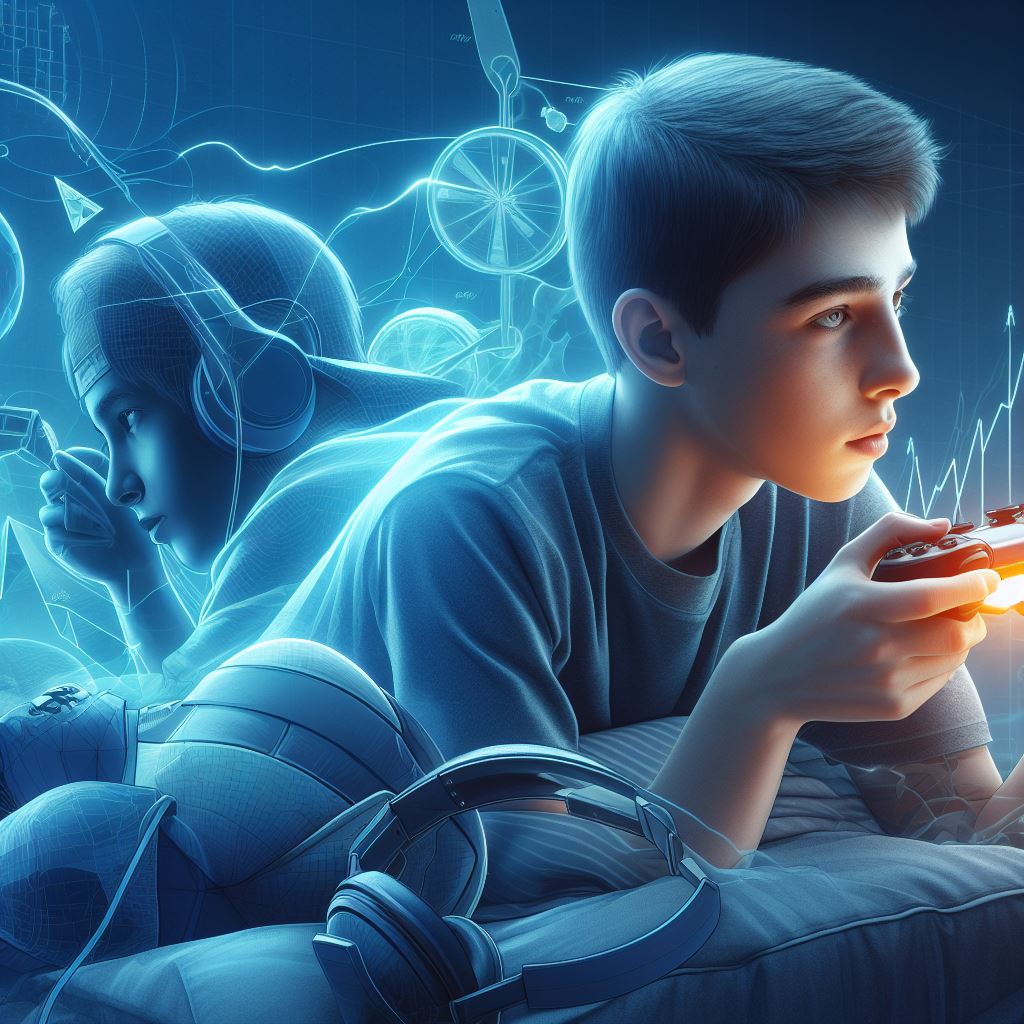 In moderation, gaming shouldn’t be affecting your children’s sleep negatively, but when gaming becomes problematic or addictive then that is associated with nervousness, tiredness, exhaustion and disrupted sleep quality[4].
A study conducted in Pakistan with 352 adolescents, found that about 7.1% of the group were addicted to gaming and a further 25% had problematic gaming behaviour. Those exact groups were the ones who reported poorer sleep quality and higher levels of tiredness[4].
Gaming addiction has the biggest influence on the sleep-wake cycle, leading to insomnia and other sleep disturbances[10].
Sleep quality can be assessed in a number of domains such as how easy it is for adolescents to go to sleep, the number of sleeping hours, and how refreshed they feel upon awakening[11].
Previous studies have shown that increased time spent on online gaming and internet use leads to several sleep disturbances including low sleep quality, sleep delays, irregular sleeping patterns, and excessive daytime sleepiness[12][13][14].
It is found that high arousal levels may interfere with the body’s soothing processes necessary for sleep as a consequence of excessive gaming[15].
My children can’t stop playing video games, are they addicted?
Problematic video game playing can have several effects on an adolescent physical and mental health and can impact the individual’s daily activities and change their behaviour[9].
Understanding why children have difficulties with stopping to play video games can educate parents how to handle excessive game playing.
Dr Michael Milham, VP Research, The Child Mind Institute
According to Dr MIlham’s theory explained in the video above, It comes down to a few simple steps that parents can do in order to prevent reactions in their children to the ones observed in the video:
- Establish clear and consistent rules about the days and times of gameplay.
- Enforce a transition period between gameplay and bedtime.
When adolescents are playing online games it causes dopamine release in the brain’s reward centre [5] which explains the potential cause for addiction.
Addiction Risk Assessment Quiz
Assessment Quiz by Clinical Psychologist Dr. Brent Conrad (this is not a substitute for a medical diagnosis).
How addiction affect my children's cognitive functions?
Studies have shown that addiction to online gaming is associated with several adverse effects on psychological health including depression and anxiety [5]. Problematic gaming is also associated with nervousness, tiredness, and exhaustion [6].
Gamers, especially those who are addicted to gaming may experience the release of dopamine which acts as a strong stimulus in spending more time playing online games[6].
Does the type of game my children play matter?
Yes, it does! Different genres of video games have been found to affect specific cognitive abilities.
Action Video Games
For example, action video games have been associated with improvements in attention and visuospatial cognition. These games typically require quick reaction times and the ability to process multiple stimuli simultaneously, which can enhance attentional control and spatial awareness skills [7].
Puzzle Games
Traditional puzzle games, such as Tetris, have been linked to improvements in navigation, perception, and recognition. These games often involve problem-solving, pattern recognition, and spatial reasoning, which can help develop cognitive abilities related to visual processing and spatial awareness [8].
MMORPGs
Mass multiplayer online role-playing games are linked to the development of a skill called telescoping – the ability to envision a path of action towards a certain goal. Adolescents playing such games are likely to develop useful life skills such as strategic thinking [3].
It is worth noting that while different genres of video games may have specific cognitive benefits, any video game has the potential to improve cognitive performance to some extent.
This suggests that video games, regardless of genre, can provide cognitive stimulation and potentially enhance various cognitive abilities.
[1] Granic, I., Lobel, A., & Engels, R. C. (2014). The benefits of playing video games. American Psychologist, 69(1), 66–78.
[2] Yu, Y., Fong, V. W. I., Li, J., Zhang, J., & Lau, J. T. F. (2023c). The independent impacts of perceived immediate and future benefits of internet gaming on internet gaming disorder among Adolescent internet gamers in China: Mediation via internet gaming time. Computers in Human Behavior, 149, 107965. https://doi.org/10.1016/j.chb.2023.107965
[3] Tassi, P. (2013). World of Warcraft lost 1.3 M subscribers in the last three months. Forbes. https://www.forbes.com/sites/insertcoin/2013/05/09/world-of-warcraft-lost-1-3m-subscribers-in-the-last-three-months/
[4] Zaman, M., Babar, S., Babar, M. S., Sabir, F., Ashraf, F., Tahir, M. J., Ullah, I., Griffiths, M. D., Lin, C., & Pakpour, A. H. (2022b). Prevalence of gaming addiction and its impact on sleep quality: A cross-sectional study from Pakistan. Annals of Medicine and Surgery, 78. https://doi.org/10.1016/j.amsu.2022.103641
[5] N. Zafar, R. Kausar, S. Pallesen, Candy Crush Addiction, Executive functioning and CGPA of university students of Lahore, Bahria J. Prof. Psychol. 17 (1) (2018 Jun 30). [29] A.M.
[6] Wittek, C. T., Finserås, T. R., Pallesen, S., Mentzoni, R. A., Hanss, D., Griffiths, M. D., & Molde, H. (2015). Prevalence and predictors of video game Addiction: A study based on a national Representative sample of gamers. International Journal of Mental Health and Addiction, 14(5), 672–686. https://doi.org/10.1007/s11469-015-9592-8
[7] Dye, M. W., Green, C. S., & Bavelier, D. (2009). Increasing speed of processing with action video games. Current Directions in Psychological Science, 18(6), 321–326. https://doi.org/10.1111/j.1467-8721.2009.01660.x
[8] Pallavicini, F., Ferrari, A., & Mantovani, F. (2018). Video Games for Well-Being: A Systematic review on the application of computer games for cognitive and emotional training in the adult population. Frontiers in Psychology, 9. https://doi.org/10.3389/fpsyg.2018.02127
[9] M´erelle S, Kleiboer A, Schotanus M, et al., Which health-related problems are associated with problematic video-gaming or social media use in adolescents?.Clin. Neuropsychiatry J. Treat Eval., 14(1), 11-19.
[10] L.T. Lam, Internet gaming addiction, problematic use of the internet, and sleep problems: a systematic review, Curr. Psychiatr. Rep. 16 (4) (2014) 444, https://doi.org/10.1007/s11920-014-0444-1
[11] ] A.C. Kharisma, R. Fitryasari, P.D. Rahmawati, Online games addiction and the decline in sleep quality of College student gamers in the online game communities in Surabaya, Indonesia, Int. J. Psychosoc. Rehabil. 24 (7) (2020).
[12] F. Canan, O. Yildirim, G. Sinani, et al., Internet addiction and sleep disturbance symptoms among T urkish high school students, Sleep Biol. Rhythm 11 (3) (2013 Jul) 210–213.
[13] J. Van den Bulck, Television viewing, computer game playing, and Internet use and self-reported time to bed and time out of bed in secondary-school children, Sleep 27 (1) (2004) 101–104, https://doi.org/10.1093/sleep/27.1.101
[14] I.N. Fossum, L.T. Nordnes, S.S. Storemark, et al., The association between use of electronic media in bed before going to sleep and insomnia symptoms, daytime sleepiness, morningness, and chronotype, Behav. Sleep Med. 12 (5) (2014)
[15] R.L. Punam¨ aki, M. Wallenius, C.H. Nygård, et al., Use of information and communication technology (ICT) and perceived health in adolescence: the role of sleeping habits and waking-time tiredness, J. Adolesc. 30 (4) (2007) 569–585, https://doi.org/10.1016/j.adolescence.2006.07.004